

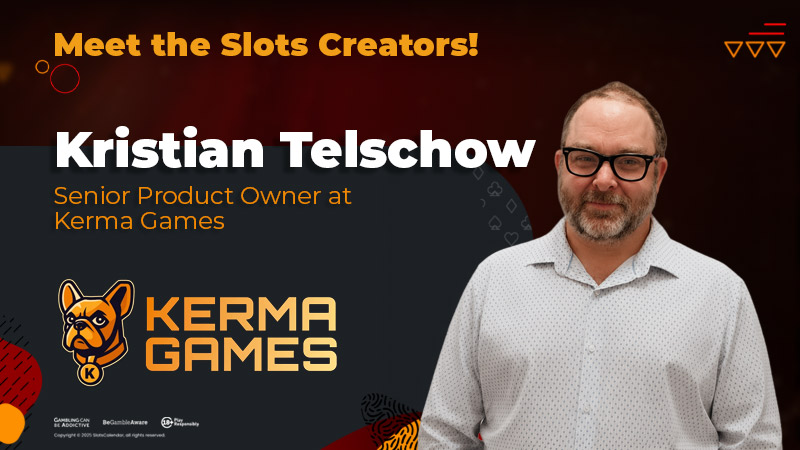
They say that a new studio’s best approach is to focus on a specific development vertical when designing games. Kristian Telschow, Product Owner at Kerma Games, soundly disagrees with that notion.
The producer’s track record up to this point indicates that they are right. However, the secret lies in the details of achieving performance through versatility. Kristian was kind enough to walk us through these factors in this interview.
Around your Alea partnership, your Head of Sales said the industry doesn't need more games, it needs experiences players actually remember. From the product side, what does "memorable" actually translate into when you're designing a game?
Ultimately, as a Senior PO, 'memorable' means moving away from commoditized math wrappers. It means delivering a product where the audio, the pop-culture narrative, and the mechanical twists work symmetrically to create an adrenaline-driven entertainment event. If the player closes the session remembering the vibe and the thrill rather than just their ending balance, we’ve built a memorable experience.
Why build across slots, crash, live casino, and table games at once, instead of going deep in one format? Most new studios pick a lane.
If Kerma Games wants to be a true innovator, sticking to one genre is a legacy mindset. The modern player demands a ecosystem of entertainment. If you look at player behavior today, the boundaries between a slot player, a crash player, and a live casino player have completely dissolved. By building across verticals from day one, we achieve three things: we capture a wider demographic for our operator partners, we create a highly efficient, modular tech stack, and most importantly, we position ourselves to design hybrid experiences that live at the intersection of these genres. That is where real innovation happens, and that’s how we stand out in a crowded market.
When "entertainment-first" and "retention-first" pull against each other in a design, which gives way?
If a design team tells me they have to sacrifice entertainment to boost retention, I tell them to go back to the drawing board. If a game isn’t fun, no amount of retention engineering will save it. At Kerma Games, we treat entertainment as our primary vehicle for retention. They don't pull against each other—they pull together to drive LTV.
Kerma's stated origin is that acquisition evolved but retention lagged. As a product owner, what does designing for retention look like in practice that designing for acquisition doesn’t?
Acquisition is just buying eyeballs with a shiny theme. Retention is engineering a product that respects the player's time and session budget. In practice, I design games so that a session ending in a net loss can still feel like a progression win. That’s how you fix a lagging retention loop—you stop building games that are flashy on day one and empty on day seven.
When a celebrity like Snoop Dogg or Lil Baby comes onto a title, how much of the game flexes to fit them, and how much stays fixed?
The entire front-end experience and game vertical can flex completely based on the celebrity's vision. By keeping our backend tech stack fixed and modular, we gain the operational freedom to build entirely new formats—like our Lil Baby Street Dice. This was a completely new type of game never before seen in traditional casino markets. Lil Baby asked for it, and we delivered. Today, the game is performing incredibly well for both us and our operator partners. We don't force a celebrity into a pre-existing game; we build the game entirely around the celebrity."
What makes a celebrity actually fit a casino game, versus just having a famous name stamped on it?
A famous name stamped on a title only buys you the first click—it’s an acquisition gimmick. What makes a celebrity actually fit a game is mechanical and cultural authenticity. When the gameplay mechanics natively match the lifestyle and energy of the celebrity's fanbase—the way street dice perfectly matched Lil Baby—that's when a title succeeds. If the core player base feels the game was built specifically for their subculture, they don't just try it once; they retain."
Snoop Dogg alone spans a crash game, a slot, and a blackjack title. How do you keep one personality coherent across three formats that play completely differently?
Ultimately, coherence doesn't mean making every game look or sound identical. Coherence means that whether a player is riding a high-speed multiplier in a crash game, or playing a calculated hand of blackjack, they feel like they are interacting with an authentic extension of Snoop Dogg. By aligning his different cultural eras and moods to the native mechanics of each format, we keep the experience entirely seamless across our entire multi-vertical portfolio.
Four new games a month is a serious pace. What has to be true about your process for that cadence not to flatten quality?
A four-game-a-month cadence doesn't flatten quality if your process is built on a modular tech stack and a smart portfolio strategy. By leveraging our engineering team's modular architecture and focusing our creative energy on the visual and behavioral differentiators, we can maintain high velocity without compromising the player experience. It’s about being a highly structured, data-driven studio.
What's the part of building a game that takes the longest but no player ever notices? People see the theme and the celebrity.
A player opens the game and sees a finished theme in a split second. What they never see is the months of intense creative heavy-lifting that happened behind the scenes—from the blank-page ideation phase where we invent the brand-new game concepts, to the relentless art production pipeline where our team custom-builds every single visual asset and animation from scratch. The math takes days; creating an authentic, high-fidelity universe for a major IP takes months."
You build the games, but operators are the ones who choose to put them in the lobby. What does an operator need to see in a title before they'll give it prime placement?
Operators don't give out prime lobby placement as a favor; they give it to games that optimize their bottom line. To get top placement, we show them a product that drives its own organic acquisition through massive IP power, acts as a cross-sell engine between their different player verticals, and utilizes persistent progression to secure long-term retention. If you prove your game protects their margins and keeps players on their platform longer, prime placement is guaranteed.
Crowded casino lobbies are the problem everyone names. Beyond a famous face, what actually makes a player stop on your game?
In a crowded lobby, cluttered graphics get ignored. We make players stop by ensuring our static key art commands attention through premium contrast and absolute mechanical clarity. We design our tiles to look like high-end entertainment brands, making it instantly obvious what the vertical and vibe of the game are. A player stops scrolling because the thumbnail gives them an instant, unobstructed visual promise of a premium experience.
More celebrity collaborations are coming. Is there a type of partner or format you're holding out for that you haven't landed yet?
We’ve mastered the art of translating subculture and music into everything from fast-paced titles like Lil Baby Street Dice to sophisticated table experiences like Snoop Dogg Blackjack. Now, I want to take that same disruptive mindset to Hollywood. Bringing cinematic storytelling, character progression, and episodic content loops into our multi-vertical stack is how we shift from being an innovative iGaming studio to a premier digital entertainment powerhouse.
A year from now, Kerma is still young and moving fast. What's the one thing you'd want an operator to say about your games then that they couldn't quite say today?
Success for me a year from now is about shifting the power dynamic. I want the biggest operators in the world knocking on our door because they know that sticking to legacy formats is a losing battle, and Kerma Games holds the blueprint for the future of interactive entertainment. I want them to look at us not just as another supplier, but as the essential innovator they cannot afford to live without.
This interview was authored by Andrei Vlaicu, with special thanks to Kristian Telschow for his invaluable contribution to the creation of this piece.