

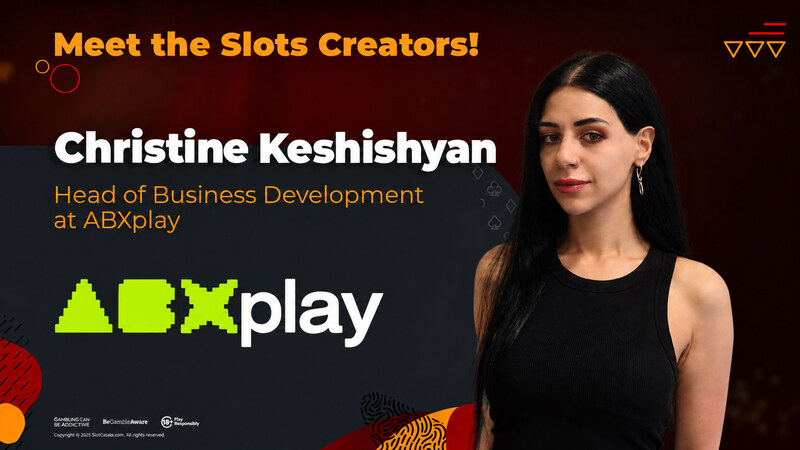
ABXplay, the game producer, has been reinventing itself while maintaining its structure. Christine Keshishyan, the Head of Business Development, is at the forefront of this effort, serving as the ultimate liaison between change and continuity.
In our discussion, Christine talks about her role and responsibilities, what they mean for the studio’s ability to progress, and the lessons she learned as a central figure in ABXplay’s endeavor to be the perfectly balanced provider.
You sell games you didn't design, to people who have hundreds of other options. What does a Head of Business Development actually do on a Tuesday that someone outside the industry would never guess?
Probably much less "selling" than people imagine. A normal Tuesday can mean chasing an integration, discussing certification for one market, reviewing game performance with an operator, solving a commercial issue, talking to the product team and then somehow finding time for new business. A big part of the job is simply making sure things actually move.
What's the part of your job that has nothing to do with selling?
Connecting the dots internally. Business development sits between operators, product, technical teams, legal, marketing and account management. Quite often my job is translating what one side needs into something the other side can actually execute.
Did the conversations with operators change after the rebrand to ABXplay? A rebrand is easy to announce and hard to make land.
Definitely. For many of our long-standing partners, the rebrand initially raised quite a few questions. We had already built strong recognition and achieved solid success in several jurisdictions, so naturally some partners wanted to understand why we were changing a brand that was already working well.
The main challenge was explaining that this was not simply a cosmetic change or a new name, but part of a broader strategic shift. ABXplay represents a different stage for us in terms of product strategy, positioning, market expansion and the way we want to build partnerships going forward.
So yes, the conversations changed. We had to spend more time explaining the reasoning behind the rebrand, while also proving through our actions that there was real substance behind it. In the end, a rebrand only works if the market starts to see and feel the difference, not just read about it in an announcement.
What did you have to explain about ABXplay that you never had to explain before?
That ABXplay is not simply the same company with a new name. We had to explain the fundamental change in product strategy, positioning and the way we approach partnerships. The rebrand gave us an opportunity to rethink quite a lot internally, but then you have to prove those changes through the product and not just through messaging.
You see games at the point where they meet the market, not where they're made. What do you notice about a title early on that tells you it'll be easy or hard to place?
Usually whether I can explain in one sentence why an operator should care about it. If the main argument is simply "another new slot", placement will be difficult. A clear mechanic, visual identity, market fit or something genuinely memorable makes the conversation much easier.
How different is the argument you make to a regulated European operator versus a crypto-first platform? ABXplay sits in both worlds, which most providers don't.
Very different. Regulated operators naturally focus much more on certification, compliance, market suitability and proven performance. Crypto-first platforms tend to move faster and are often more open to experimentation and different mechanics. The product still has to work, but the priorities and the pace of the conversation are not the same.
In a recent LinkedIn post you mentioned ABXplay made mistakes that forced you to rethink your processes. Can you name one?
For a period, we focused too much on the quantity of releases. Producing more games does not automatically create more value, especially if the differentiation between titles becomes too small. We are now much more focused on building fewer, stronger products with a clearer reason to exist. We closely follow industry trends, new mechanics and features, but not only on a global level. We look at them market by market, because what works well in one jurisdiction may perform very differently in another. Our goal is to continuously adapt, implement relevant functionality and keep our games competitive and up to date. Going forward, I believe we will focus more on a selected number of titles, improving their quality, mechanics and overall player experience, rather than simply expanding the portfolio for the sake of having more games.
What's a game you personally believed in that the market didn't?
There was one title I was personally very confident about because I liked the concept and presentation, but commercially it simply didn't get the traction I expected. I would probably keep the title anonymous to protect the innocent! It was a useful reminder that personal taste and market behaviour are two very different things.
How do you stay honest with a partner when the honest answer costs you the deal? Trust is easy to claim and expensive to practice.
By accepting that not every deal should be closed. If I know we cannot deliver something properly, I would rather say it immediately than sell a promise that becomes a problem three months later. Losing one opportunity is cheaper than losing a partner's trust.
What's something you believed about this industry five years ago that you don't now?
I’ve mentioned this in a previous interview, and I’ll repeat it because I still see it as one of the biggest lessons I’ve learned.
Five years ago, I thought that signing the deal and completing the integration was most of the job. Now I know it’s only the beginning. The real work starts after launch - with positioning, visibility, market understanding and constant partner support.
That’s also why we’ve invested a lot of resources not only into the product, but into building a strong team around it. And honestly, the quality of the team is probably what I’m most proud of today.
A year from now, what would you want an operator to say about working with ABXplay that they couldn't quite say today?
That ABXplay has become a provider they actively look forward to hearing from - not because we release constantly, but because when we release something, it is worth paying attention to. And on the partnership side, that we are fast, reliable, transparent and genuinely easy to work with.
This interview was authored by Andrei Vlaicu, with special thanks to Christine Keshishyan for her invaluable contribution to the creation of this piece.