

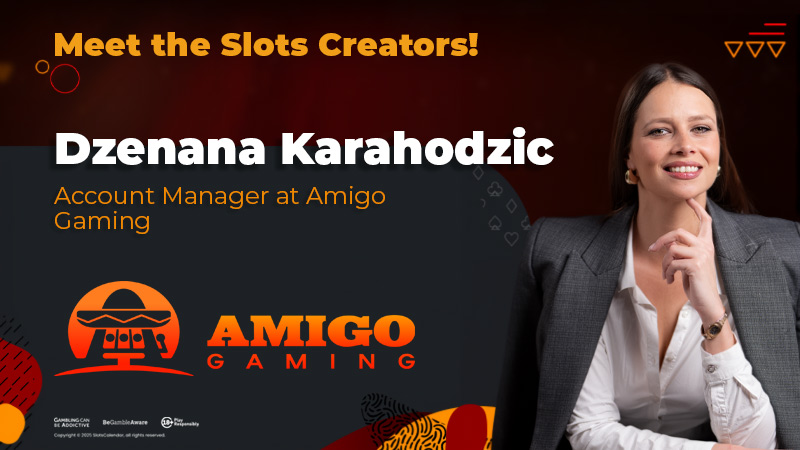
An account manager at a high-profile studio like Amigo Gaming means being a liaison that hears, understands, and communicates. Dzenana Karahodzic, the producer’s Account Management Team Lead, has first-hand experience with the entire process.
With a background in all things commerce, but also a trailblazing figure in iGaming, Dzenana’s time in this industry has yielded a profound understanding of the studio-operator dynamic. She took the time to fill us in on this unique part of the online gambling funnel.
1. You spent your first months at Amigo in customer support before moving into account management. What did support teach you that the account-manager training never could?
Support teaches you the reality of friction. In account management training, you learn about pipelines, commercial growth, and partnership strategies on a spreadsheet. But in support, you are on the front lines understanding the operator's daily experience. It teaches you to view every single game rollout through the partner's technical lens. I am glad I had those first months because they gave me the tools to be a much more practical Account Manager. I do not just focus on delivering our portfolio; I focus on ensuring the integration is a smooth and seamless process for our partners.
2. Three years in, what's something about being an Account Manager in iGaming that surprised you that nobody warns you about in the job description?
Job descriptions usually focus on standard targets like closing major deals or expanding market share. What surprised me is the daily rhythm of acting as a direct bridge between the operator's immediate commercial goals and our studio's technical capacity. You are constantly collaborating, learning, and finding creative business solutions in real time. It requires a lot of agility to keep both sides aligned, but that is exactly what makes the job so rewarding. Two years in, I love the fact that no two days are ever the same.
3. Your colleagues cover LATAM, CIS, and Africa. You're closer to the Balkans and SEE. What do operators in this region care about that operators elsewhere don't?
Operators in the Balkans and Southeastern Europe are very straightforward and they don't really care about flashy elements or overcomplicated setups. While my colleagues handling other regions often tell me that their clients look for complex bonus games or heavy animations, operators in my markets are completely focused on math and stability. They know their local players perfectly, and those players want classic themes, clean fruit games, and high volatility. They just want to open a game, feel a solid math model, and trust that it performs reliably. It is a fantastic region to work with because that direct honesty pushes us as a studio to keep our games sharp and competitive.
4. When a new game lands in an operator's lobby, what happens in the first 48 hours that tells you whether it's going to perform?
The first 48 hours give you an honest look at the organic player connection. I closely monitor the initial bet counts and player session durations. We look for how many individual sessions are being generated naturally, without heavy promotions. If players open the game and stay engaged during those first two days, it tells us that our visual assets, themes, and loading speeds did their job. High early retention in that initial window is the truest indicator that a game has successfully connected with the audience and will have a strong lifecycle in that lobby.
5. Operators ask for branded games, exclusive content, custom math, deeper RTP ranges, instant integrations. When everyone wants something custom, how do you decide who gets what?
It is a good challenge to have because it shows how much operators value our content. To balance this, we decide who gets what by looking closely at historical data and long term strategic alignment, prioritizing projects where custom development can drive the highest mutual growth for both companies. Of course, because these bespoke projects take significant time from our developers, our core strategy is to ensure that our standard portfolio is already exceptional. This way, even our general monthly releases deliver premium commercial value out of the box, giving any operator a top tier product without them needing to wait for full customization.
6. Amigo released around 50 games this year. From where you sit, do operators actually want that pace, or would two or three really strong releases per month land better?
Operators are always fighting for player attention in an incredibly competitive space where fresh content is what keeps lobbies vibrant and drives daily engagement. Because of that, they genuinely welcome a consistent and reliable stream of games to fuel their ongoing marketing campaigns. For us, releasing around fifty games a year actually hits a great sweet spot, averaging about four releases a month. It provides our partners with the continuous novelty they need, but without overwhelming them. This pace only works because our studio places a huge emphasis on rigorous quality assurance and smooth API integration, which means we can maintain this exciting momentum while ensuring that every single title lands fully certified, completely stable, and ready to perform right out of the box.
7. What do you wish operators understood about the studio side that they often don't?
If I had to focus on one thing, I wish they could see the incredible amount of dedication and compliance work that goes into every single game asset. When an operator asks for a minor adjustment, it might seem simple from the outside, but on the studio side, it actually sets off a thorough chain of teamwork where our developers, designers, and compliance teams work together. We do this because keeping our game models and mechanics completely uncompromised is what protects our partners, giving them the absolute peace of mind that their operations remain secure and profitable long term.
8. A lot of women in this industry talk about visibility. From an Account Manager's seat, where do you see the real gap, and where are things genuinely improving?
While the industry has historically had gaps in operational leadership, things are genuinely improving. From my seat at Amigo Gaming, I see an environment where performance and talent lead the way. Women are increasingly driving major commercial negotiations, managing key global accounts, and shaping product roadmaps. The shift is moving away from just talking about inclusion to actively seeing women hold real operational ownership and commercial influence. It is a very positive time to be a woman in iGaming.
9. What's one thing you'd change about how studios and operators work together, if you could rewrite the rulebook?
If I could add a new rule, it would be to create an even closer, real time data sharing partnership. Right now, the relationship can sometimes be a bit transactional. If we could sync our insights and player feedback more dynamically, we could collaborate even faster to tailor our monthly releases to emerging trends. A tighter, more transparent feedback loop would allow us to support our operators' revenue goals even better while fueling our creative process on the studio side.
10. A year from now, what would make you look back and say that was the year that mattered for you at Amigo?
It would be looking back and seeing that the partnerships I manage have achieved steady, record breaking growth because of the tailored strategies we executed together. For me, a meaningful year means knowing that our operators do not just see Amigo Gaming as another provider on their platform, but as a trusted strategic ally that genuinely helps them conquer their target markets.
This interview was authored by Andrei Vlaicu, with special thanks to Dzenana Karahodzic for her invaluable contribution to the creation of this piece.