

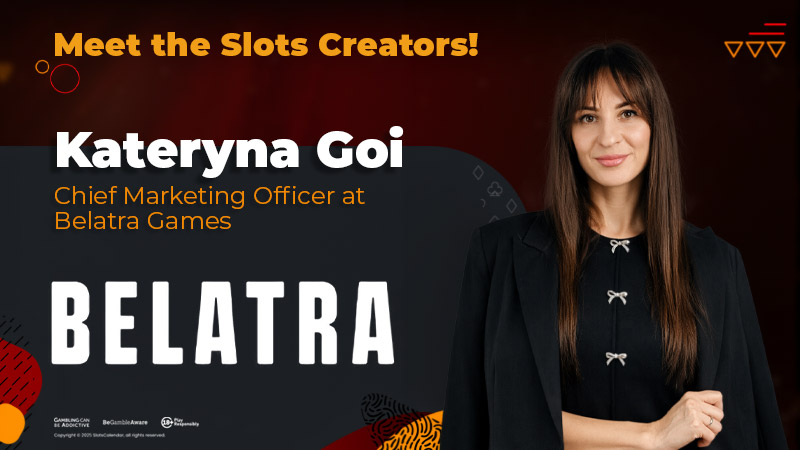
A company in the iGaming world is as good as its status, and Belatra Games harnesses this fact with utmost commitment. Its consistent presentation supports a game portfolio that has consistently showcased its quality.
Kateryna Goi, Belatra’s Chief Marketing Officer, oversees the brand consolidation strategy that inspires confidence among the studio’s partners. She took the time to provide us with highly insightful details from both her professional background and her strategic vision.
Before Belatra, you helped run the exhibitions and conferences where this industry meets. Then you crossed over to a company that shows up in those rooms. What did organising those events teach you that you only really understood once you were the one exhibiting?
Yes, I spent almost five years organising conferences and exhibitions — back when this format wasn't yet the industry mainstream, long before event calendars listed over a hundred different shows a year. That experience still fascinates me to this day; there's nothing quite like standing in the middle of the energy a major exhibition generates.
What surprised me, once I moved to the other side of the table as an exhibitor, was how differently you read the same event. On the organiser side, you're focused on logistics, flow, and making sure the show runs flawlessly as a whole. As an exhibitor, you suddenly see it through the lens of ROI, audience attention, and what actually drives a visitor to stop at your booth rather than walk past it.
It also gave me a much sharper understanding of where exhibition budgets come from and how they're built — which sounds simple, but completely changes how you plan your own presence. You stop thinking about a booth as a physical space you rent, and start thinking about it as a piece of strategic communication that has to justify itself in leads, conversations, and brand recall. That perspective shift is something you only really get once you've been on both sides
What part of your job shapes the games in ways players and partners never see?
Honestly, I don't influence game design or mechanics directly — that's the studio's craft, and it should stay that way. But marketing shapes the games in ways that aren't always visible from the outside.
We're the ones who sit closest to the market — we see which themes resonate in which regions, what players talk about, what partners are asking for before they even put it into a request. That intelligence flows back into the product conversation. A marketing team that's paying attention can flag a trend six months before it becomes obvious, and that timing often decides whether a game launches into a wave or against it.
There's also the positioning layer — how a game is framed, what story it tells, what audience it's built to win over. That doesn't change a single line of game logic, but it absolutely shapes how a title performs once it's live.
In practice, this is where marketing takes real ownership: we decide how a specific title gets presented in a specific market — which angle resonates with which audience, which channels and sources actually reach them, and what the right tone is for that region. We build the promotional campaigns around each release ourselves, run them, and then we're the ones gathering the feedback afterwards — what landed, what didn't, what players and partners actually responded to.
That feedback loop is where it comes full circle. It feeds back into the product conversation, into how the next title is framed, and sometimes into the roadmap itself. So if I had to define it: I don't shape the games themselves, but I shape the context they're released into, the way the market first meets them — and over time, that context becomes part of what makes a game succeed or fail.
Belatra has a reputation for classic, recognisable slots rather than chasing every new mechanic. From a marketing seat, is that restraint easy to sell, or do you sometimes wish the studio took bigger swings?
It's honestly an easy story to tell, because it's true rather than constructed. Right now the market is flooded with new providers, and almost every single one of them claims to be launching something the industry has never seen before. But if we're being honest, genuine innovation in this space is incredibly rare these days — most of what's branded as "new" is a variation on mechanics that already exist.
Belatra has been on this market for 33 years. Over that time, we've found our niche and built a format that works — proven, timeless classics rather than chasing every new trend. I like to compare it to a little black dress: it stays relevant generation after generation, no matter how fast fashion moves around it. That's exactly the role our games play — they don't need to reinvent themselves every season to stay desirable. Nevertheless, restraint does not mean limitation. Our portfolio spans 9 different game types, built to match a wide range of player preferences. So we're not standing still — we're disciplined about where we innovate and where we stay true to what works.
From a marketing seat, that's actually a privilege to sell. We're not promising a revolution we can't fully stand behind every single time. We're offering something the player can trust, and we take full ownership and responsibility for that quality. In a market this noisy, reliability has become its own competitive advantage.
Coming from Endorphina, what did you have to unlearn when you moved to a brand carrying 30 years of history?
Honestly, these are two completely different companies, with completely different approaches to marketing — and to how processes work overall. Moving from one to the other meant rethinking my whole approach to marketing activities and promotional campaigns from the ground up.
If I had to describe the contrast: Endorphina is the rebel — a brand that can't help but grab attention, and does it remarkably well. Belatra is the reliable friend — the one who shows up consistently, delivers quality, and never takes unnecessary risks or steps outside its own boundaries.
Belatra is a mature, status-driven brand carrying over three decades of history, and that history shapes literally everything — our booths, our merchandise, our promotional campaigns, the tone of our communication, the atmosphere around the brand as a whole. There's no part of it that exists in isolation from that legacy.
A simple example: when we're selecting materials for merchandise — gifts for our clients and partners — we can't even consider cheaper, lower-quality options. Our status simply doesn't allow it. And that same standard applies to every single aspect of the brand, without exception.
So what I had to unlearn wasn't a skill — it was a mindset. At Endorphina, boldness was the strategy. At Belatra, restraint and consistency are the strategy, and they require just as much discipline, if not more.
When a new game first lands on your desk, what's the first question you ask about it?
The very first thing I ask is whether there's context — a backstory, a hero, a narrative thread that connects this game to others in our universe. Anyone who knows Belatra knows how much we love building worlds around our characters, so that's always my starting point: does this title belong to an existing universe, or is it the seed of a new one?
From there, the questions get more strategic. Who is this game actually built for — which player profile, which region, which audience does it speak to first? What makes it stand out within our own portfolio, so we're not cannibalising the attention of another title we already have live? And what's the one thing about this game that gives us a genuine hook for a campaign — a visual, a story beat, a mechanic — something we can build a promotional angle around rather than just announcing "a new release."
I also think ahead to distribution: which markets and partners should see this first, and through which channels — social, trade media, our own events — will it land best. And finally, I always ask what success looks like for this title, so that once it's live, we know exactly what to measure and feed back into how we position the next one.
So it's never just one question — it's really a short checklist that starts with story and ends with a measurable plan
With the DanLudan Fortune Bass release, you built a game around a real streamer's likeness. What has to be true for a collaboration like that to land, and not feel like a cash-in to players?
For a collaboration like this to land, it has to come from genuine community demand, not a marketing calculation. With DanLudan Fortune Bass, the idea didn't start in a boardroom — it started with our players. Our fishing game Blast the Bass already had a loyal, passionate audience, and at the same time, that same audience was deeply engaged with DanLudan as a streamer. We noticed the overlap and listened to what the community was actually asking for.
What made it feel authentic rather than a cash-in is that DanLudan was involved at every stage of development — his input genuinely shaped the game, not just his name and likeness slapped on top of an existing product. He has real trust with his audience, and that connection goes both ways, so bringing him into a game players already loved wasn't about borrowing his fame for visibility.
And the results speak for themselves: the game went straight into our top 10 and has stayed there ever since. That tells us the collaboration wasn't just well-received — it was exactly what the audience wanted. Honestly, this won't be our last collaboration like this. When you see numbers and feedback like that, it's a clear signal to keep going in that direction.
How do you decide a character is worth a whole universe and not just one good game? The Mummy clearly crossed that line at some point.
I remember at one expo, a young man came up to our booth and told us that Mummy wasn't just a character to him anymore — it was his friend, his entertainment, his companion. That moment really stuck with me. So for us, it's never a decision we make in a vacuum — it's the audience who tells us when a character has crossed that line.
That's when you know you've created something bigger than a single good game: when a character becomes instantly recognizable, when players see even a glimpse of it somewhere and immediately know it's Belatra. That kind of recall isn't something you can manufacture through marketing alone — it has to be earned through the character actually resonating with people. And honestly, this comes back to what I mentioned earlier — we're a team that listens closely to our audience and gives them what they're asking for. With Mummy, the audience told us, through their engagement and their loyalty, that there was more story to tell. So expanding it into a universe wasn't really our decision in isolation — it was a response to what players had already shown us they wanted.
Feedback pours in from operators, streamers, and events. How do you tell the difference between a loud request and a signal that should actually change a game?
All of us in this industry understand perfectly well that it's impossible to please everyone, and every provider receives harsh criticism from time to time — that's just part of the territory. The key for us is scale and consistency. A single drive-by comment that disappears and never comes back is noise. A signal is when the same theme starts showing up repeatedly, from different directions, over time.
We have a pretty engaged Telegram community — where members share their thoughts openly, and that's often where we first spot a pattern. But when that same sentiment is echoed by streamers, and especially by operators, that's when it becomes impossible to ignore. Operators don't request things lightly — they're reacting to real player behavior and demand.
Honestly, the clearest proof point for us has been Mummy. The sheer number of exclusives operators have wanted to build around that character speaks for itself — that's not a loud request, that's a strong signal of product quality and a clear direction we needed to keep building in.
There's the game the studio wants to make, the game operators ask for, and the game players end up loving. When those three pull in different directions, who wins, and how do you make that call?
In this matter, it is important to consider the entire chain—the provider, the operator, and the player—and identify those who are actually driving this process
If a studio builds something visually stunning and genuinely different — something the team sees as their masterpiece — but it turns out too complex, too heavy, or visually overwhelming for players, they'll simply skip it and never come back. And in that case, no matter how proud the studio is of it, that game ends up at the bottom of the list. Player reaction is the real test, not internal enthusiasm.
As for operators, in our experience they rarely ask for something that wouldn't resonate with players in the first place — operators are constantly running their own analytics and know player preferences inside out. So more often than not, what operators request and what players actually love end up overlapping rather than pulling in opposite directions.
Therefore, if there is a real conflict, it usually arises between the studio's ambitions and the players' behavior, not between operators and players. And when that happens, player behavior wins, every time — because that's the only signal that tells us whether something will actually work in the market, not just look good in a pitch deck.
Belatra ships new games at a steady, almost monthly pace. What does that release rhythm do to marketing, and what gets sacrificed when the calendar never really stops?
I'd actually push back a little on the word 'sacrificed.' For us, every new release isn't a routine item on a calendar — it's an event. Each game gets its own PR strategy: dedicated social content, press releases, digests, affiliate reviews, coverage in our Telegram community — we genuinely try to make sure the world hears about every single release.
What makes this possible is that we don't do reskins. Every Belatra game is a new product, not the same mechanic with a fresh coat of paint. And let's be honest — that's extremely common in this industry right now. A provider's game sits in the 'New' section every week or two, but what does the player actually find when they click in? The same mechanic they've already played, just reskinned for the tenth time. Players notice that immediately, and they leave. So our goal with this release rhythm isn't to keep up appearances — it's to make sure we never disappoint the player who clicks on something new expecting something new. That's actually what shapes our marketing calendar more than the pace itself: every release earns its own real campaign because every release is a real, distinct product.
When the data points one way and your instinct points the other, which do you trust, and can you remember a time you went with your gut and it paid off?
When it comes to scale—pricing, customer retention curves, channel effectiveness—data should always take precedence. In this regard, the numbers don’t lie, and there’s no room for ego here. But intuition becomes valuable precisely in those cases where data is not yet available or cannot be measured.
I remember giving the green light to a campaign even though all the metrics we had suggested we wait—engagement rates were below the threshold, and the format was untested with our audience. But the timing felt right, so we went for it anyway. That quarter, the campaign outperformed all the others. In hindsight, the data wasn’t measuring what it should have—it was being compared to the old format, not to the new behavior we were trying to capture.
So my rule is this: trust the data to find out what happened. Trust your intuition to figure out what should happen before the data comes in to confirm it.
A year from now, what is the one thing you'd want an operator or a player to say about Belatra that they can't quite say today?
A year from now, I want an operator to say: 'Belatra is the partner we can't imagine our lobby without.' Not just a provider on the list — but the one they'd genuinely miss if we weren't there. That's a very different thing. And from a player — I want to hear: 'I don't just play Belatra games, I come back for them.' That feeling of returning, not by habit but by choice, because something about our games genuinely pulls them in.
Honestly? I think we're closer to both of those than people might expect. The foundation is already there — the characters, the community, the products that players call their friends, not just their entertainment. What's missing is scale. A year from now, I want that recognition to be impossible to ignore — not just in the markets where we're already strong, but in the ones where Belatra is still a name people are just beginning to learn.
We're not building toward that. We're already moving.
This interview was authored by Andrei Vlaicu, with special thanks to Katerina Goi for his invaluable contribution to the creation of this piece.