

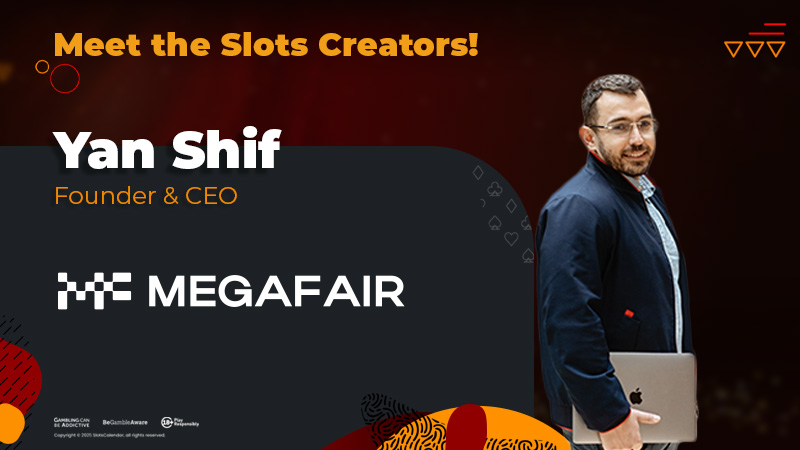
MEGAFAIR, a name that is still consolidating its mass popularity in the world of iGaming, has been one of the most versatile producers to have entered the market in the last decade. With a portfolio characterized by skill and hybrid games, aside from traditional gambling solutions, MEGAFAIR is at the forefront of the industry’s overall development.
Yan Shif, Founder and CEO, leveraged his background and understanding of the industry to turn MEGAFAIR into a visionary, but highly practical brand. In this interview, he discusses the core principles of his studio, but also several fascinating insights into his perception of the iGaming industry.
You’ve built businesses since the age of 13, from marketing to gaming. What drew you personally to start MEGAFAIR — and why have you started with skill-based games?
Entrepreneurship has been my passion since I remember myself. I enjoy the process of building something meaningful and innovative, not just running for success. I shifted my focus from marketing to the rapidly growing gaming market around 2019, recognizing its explosive potential.
The strategic decision to launch MEGAFAIR with skill games was born when I considered an opportunity to combine gambling elements with casual gaming. This direction gave us a clear market advantage due to minimal regulatory hurdles. The model was quickly validated by existing casino clients and confirmed by data showing the rapid popularity of these games in mobile store rankings. We officially launched the company in 2022, and by 2025, we already boast a team of around 40 employees.
You’ve described MEGAFAIR as “creating the future of entertainment.” In your words, where do you see the biggest gaps or opportunities in the current market that MEGAFAIR is aiming to fill?
New game formats, creative game features, and social experience will define the future of iGaming. And I think the future of entertainment demands meaningful competition and a sense of mastery. We’re actually filling the gaps. MEGAFAIR started pioneering skill-cash gaming to capture new audiences. We proceed by offering hybrid slots and a blend of traditional and innovative casino games.
Ultimately, iGaming is about entertainment and connection. We aim to deliver experiences that spark excitement and keep players coming back. In our Megaverse every player can discover a fresh experience designed to challenge their skills and deliver pure fun.
MEGAFAIR started with a bold mission around skill-based games — how has your vision evolved as the company now also expands into RNG and hybrid experiences?
We had and still have one core mission: to make people happy, manifested in our "happy-happy-happy" formula. When players are happy, our partners are happy, and that happiness extends to everyone at MEGAFAIR. This guiding principle has not changed, but the path to achieve it has broadened.
We initially began with skill games, strategically positioning them as a highly effective top-of-funnel acquisition tool. This decision was validated by several cases. Then our vision evolved to serve the broader needs of our partners. We decided to add RNG and hybrid titles to respond directly to client demand. That’s how we came to the idea of a two-track portfolio, which combines skill titles with high-stakes RNG and unique hybrid slots like Crazy Zeus Run.
This expansion is not an abandonment of skill, it's a strategic move to satisfy all operator needs and implement a structured acquisition strategy that maximizes LTV. By offering both tracks, we build a balanced portfolio that gives operators the tools for a smart-funnel game approach, securing both high engagement (via skill) and high revenue (via RNG).
What makes a great RNG game? What key elements must be present to deliver the “happy-happy-happy” experience you aim for?
For me, a great RNG isn't defined by its theme, but by the feel. The core experience must deliver that "happy-happy-happy" feeling.
This requires a perfect mix of technical precision and emotional engineering. The game must have aesthetics, strong visuals, and aligned sound effects, plus a kind of a "secret ingredient" — a tiny detail that makes it different from similar thematic games.
The rhythm of the game must make every spin or reveal feel exciting, creating the anticipation and rising tension for the big win. The game must feature memorable effect triggers that create instant chills, kind of that pause of suspense when two symbols land before the third one drops. When all elements align, even a slot with fewer features can hook a player harder than one loaded with extras. I think we have succeeded, seeing as one of our debut RNG titles Crazy Zeus Run was recognized by the European iGaming Awards and shortlisted in two categories.
You’ve shared how AI-driven matchmaking is central to your platform. How do you see this technology evolving to further personalize player experiences?
MEGAFAIR’s global matchmaking system is a game-changer, as it ensures increased participation by connecting players across different platforms. Matchmaking algorithms guarantee fairness and balance. Players are matched based on comparable experience, with someone who has played the same amount of games and has been in the system for a similar amount of time. So new users aren't pitted against veterans. We see this technology evolving toward hyper-personalization. I mean moving beyond just skill level to focus on predictive preferences, where AI can predict players' behaviour, stake levels, and optimal session times. AI tools could also implement dynamic volatility, tailoring a game's difficulty or volatility to the player's temperament, maximizing engagement without relying on static settings.
Finally, we are actively expanding partnerships so the algorithm can foster an enhanced community by pairing players not just by skill, but by complementary social and competitive play styles. All this is aimed to make the game feel uniquely tailored to the individual, and boost long-term engagement as a result.
Many operators struggle with player retention. How do MEGAFAIR’s games uniquely support long-term player engagement?
MEGAFAIR offers a balanced two-track portfolio designed to maximize sustained LTV to support long-term player engagement. Our foundational strategy starts with blending gambling with skill gaming to focus on player retention and engagement. We strategically position skill-based games as a top-of-funnel acquisition tool that drives high engagement and helps keep customer acquisition costs low. They are less challenging to market than traditional gambling because mostly they don't fall under the strict regulations, reaching new audiences interested in wins through skills. Skill games are perfect for cross-promotion and creating habits, encouraging mastery, and keeping players coming back. One major gaming platform in LATAM successfully implemented our skill-cash games and managed to increase the average bet while achieving about 10% more user time.
Our RNG and hybrid titles have a high-revenue potential. MEGAFAIR provides a complete player journey: from the first click to becoming high-value, premium depositors.
For operators exploring your portfolio: How do MEGAFAIR’s games drive incremental revenue and player lifetime value compared to traditional slot games?
MEGAFAIR’s games drive incremental revenue and higher Player LTV by changing the customer acquisition process and establishing a strategic monetization funnel that traditional slot games cannot match. Our skill-cash games like Mega Bingo Cash and Mega Solitaire serve as low-barrier acquisition tools. They are often classified as non-gambling by platforms like Facebook. We achieved about 40% lower acquisition costs for one of our UK partners. Once acquired, skill players stay longer with better engagement and retention metrics, which directly boost LTV. The primary driver of incremental revenue is the strategic funnel design that guides these low-CPA users into high-margin games and converts engaged players into long-term customers. This high-trust, high-engagement strategy results in a robust 16% cross-game migration rate to high-margin content, guaranteeing sustained LTV.
You often emphasize fairness and transparency in your games. Why do you believe this is becoming such a key factor in player acquisition and retention in today’s market?
Fairness and transparency are now a new must, they're the core for building trust and community in a market driven by a digitally native audience.
The younger generation has grown up with a wide range of competitive video games, with clear rules and skill-based rankings. They expect genuine challenges, not just pure luck, and they are more savvy about game mechanics. When they first taste iGaming, those expectations for absolute transparency remain high.
MEGAFAIR considers fairness as our competitive edge. We believe in earning trust. Our AI-driven matchmaking ensures our mechanics are transparent and competition is fair.
The iGaming world is watching trends like crypto, web3, casual gaming mechanics, and social competition. Which of these do you think will most reshape the space over the next 2-3 years — and why?
The trend that will most significantly reshape the iGaming space over the next 2-3 years is the merge of casual gaming mechanics and social competition.
Web3 and crypto are certainly important for ownership and transactions. Crypto casinos offer fluent processing and keep growing. New gen players are used to the blockchain ecosystem and Web3 concept. But the true driver of mass market expansion and retention is the ability to make gambling feel like a highly engaging social competitive game. This involves integrating features like tournaments, live leaderboards, and the AI-driven matchmaking to ensure competition. The trend also addresses the player acquisition problem: blending gambling with casual gaming allows operators to reach new audiences. We are on trend offering unique hybrid and skill experiences to capture and retain the new demographics of players accustomed to a high level of digital engagement and social interaction.
With MEGAFAIR’s global matchmaking model, how do player behaviours differ across key markets (US, EU, LatAm, Asia)? What regional insights have surprised you?
The matchmaking algorithm focuses on identifying key player similarities, not differences, to ensure balanced and comparable competition. The biggest regional surprise is the inconsistent regulatory landscape across different markets. It’s frustrating when local rules suddenly redefine skill games, placing them under the same category as traditional gambling. Such changes don’t just affect the operators, but impact player choice as well, forcing players to move to unregulated, illegal casino sites.
In mature markets like the EU, player acquisition is often driven by highly compliant, transparent mechanics that satisfy a high expectation for fairness.
Asia shows a massive appetite for speed and high-session-count gameplay, driving demand for fast-paced thrilling titles.
The most profound regional insight came from the success of our hybrid title, Crazy Zeus Run, which proved to be most popular in LatAm. It really surprised us because it showed that LatAm players aren't just looking for simple, high-stakes RNG, popular everywhere. Instead, they move towards complex hybrid experiences that reward genuine mastery and long-term involvement. They're seeking deep engagement and continuous play, not just a quick win.
Skill-based games often attract younger audiences — what other audiences or player profiles are you seeing adopt these games in practice?
While skill games are highly effective with younger audiences, the most significant adoption comes from two other player profiles.
First, we effectively capture audiences that might not be interested in traditional slot games but are motivated by the chance to win some money through their perceived skills and competitive challenge. This is the new demographic we access because skill games are easier to market and mix gambling with casual gaming. Second, we see strong adoption from players seeking long-term engagement and mastery, who want to improve their skills. Our games are designed to encourage mastery and appeal to the competitive profile that values fairness and continuous involvement through features like fair matchmaking and leaderboards. These players are seeking genuine, sustained challenge over quick, passive luck.
You’ve mentioned plans to expand both skill-based and RNG content — can you give us a sneak peek at what kinds of new innovations or mechanics your team is excited about right now?
We still believe skill games are a key part of the future of iGaming. But we also recognize that RNG games remain a dominant force in the market. So we try to keep this balance.
We put most of our efforts into proven strategies, focusing on what already works, optimizing RNG mechanics, and delivering retention-driven slots. About a quarter of our efforts goes to experiments, pushing the boundaries with innovative hybrid concepts like Crazy Zeus Run.
This strategic split allows us to focus on current market needs while introducing exciting, new experiences, like implementing the thematic verticality in our crash releases. Our two-track portfolio aims to deliver both innovation and market-proven engagement models.
Strategically, we are focused on massive product expansion and market share growth. In 2026, we are committing to a packed launch schedule. Expect a full slate of releases including retention-focused slots, thrilling crash titles, some reskins and the launch of our first official Megaways, all crafted to define the next era of gaming content for our partners.
This interview was authored by Andrei Vlaicu, with special thanks to Yan Shif for his invaluable contribution to the creation of this piece.