
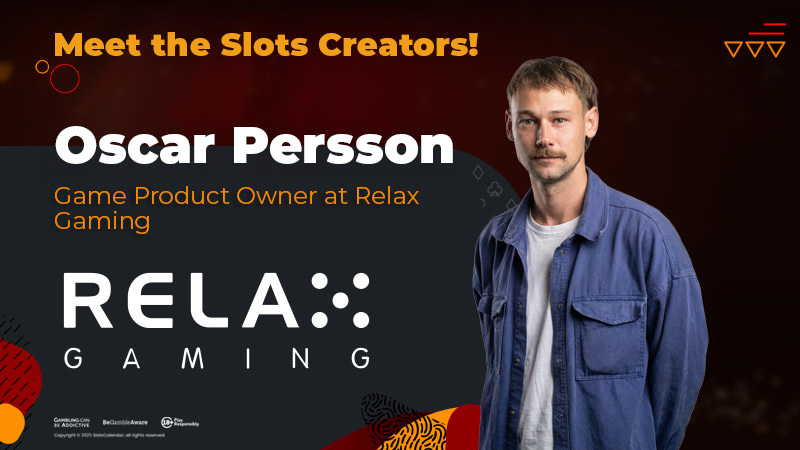
Community voice-turned-Product Owner Oscar Persson knows what it’s like to turn the seed of an idea into a game that’s worth playing. Naturally, it’s infinitely easier said than done, especially when competition is so ferocious in iGaming.
As a driving voice in slot development at Relax Gaming, Oscar sat down with us and walked us through his perspective on game creation, the studio’s next steps, and his particular experiences in his role. Read our exclusive interview for a fascinating tell-all!
For the readers meeting you for the first time, how would you describe what a Game Product Owner actually does at Relax Gaming?
It usually starts with a random idea. Shower, car, or a slightly rough Sunday morning after one too many tequilas. Doesn’t matter. If you think “that could actually be a sick game”, that’s step one.
But ideas are cheap. If you can’t sell it, it’s worthless.
So, the real job starts there. You build a pitch that explains why this game deserves to exist, what it feels like, how it pays, how the bonus works, why players would care. It’s part blueprint, part sales job.
If it gets approved, you team up with a mathematician and start shaping the experience for real. How often do things hit, how big can it go, does it feel exciting or just noisy? A lot of ideas die or change here.
Then you go into production with a studio, and that’s where it becomes a game. Week by week it goes from numbers on a screen to something real. My job through all of this is pretty simple. Make sure it actually feels good when you play it. If it doesn’t, we’re not done. If it does, we ship it.
You spent a lot of time as a slot streamer before moving into game development. What finally pushed you from critiquing games on stream to creating them?
I was a slot streamer full-time for over five years. I sometimes joke that it gave me a PhD in slots.
Playing games in front of an audience gives you a very different perspective. You don’t just see how a game works, you feel where it’s boring, where it drags, and where it actually delivers. I spent years thinking, “why didn’t they do this instead?”
At some point, that turns into frustration. You stop just critiquing and start wanting to build it yourself. So, moving into game development felt like a very natural step. Now I get to take all those thoughts I had as a player and actually turn them into real games.
You’ve essentially gone from power-user to creator: from streaming of bonuses to deciding how those bonuses work. If a young streamer tells you they want to follow your path into game design, what concrete first step do you tell them to take?
My job is to make good games, and knowing what actually defines a good game is a huge advantage.
As a streamer, you get a unique combination of hands-on experience and constant player feedback. If you actually listen to your audience, it’s basically like running a focus group every single day.
A lot of providers copy popular mechanics from each other. But you can’t copy something properly if you don’t understand why it works in the first place.
That’s where streamers have an edge. You know what you like, you know what your audience reacts to, and most importantly, you know why.
My advice is simple. Pay attention, break games down, understand what makes them hit. And if you can also sell your ideas, just go for it.
When you sit down with a new concept today, what habits or instincts from your player/community days kick in first?
If you asked everyone on my team how they start a project, you’d probably get completely different answers.
For me, ideas come in pieces. It might just be a base game feature, or a rough idea for a bonus. I usually write it down in my phone or start building it out in a PowerPoint. I never force a specific idea. I keep multiple concepts alive and focus on the one that feels the strongest.
Where my player background really kicks in is when the idea starts to take shape. That’s when I begin tailoring parts of the game around how I know players actually think and react.
What will make them stay? What will feel rewarding? What will feel frustrating? That instinct comes directly from years of playing and watching players react in real time.
Relax is known for sequels and spin-offs that actually move series forward – from Money Train 4 and Ancient Tumble to Bill & Coin 2 and now Iron Bank 2. In your view, what separates a “necessary sequel” from a pure cash-grab?
A good sequel shouldn’t move too far away from what made the original work. But if it doesn’t bring anything new, then what’s the point?
For me, it’s about evolution, not repetition. You keep the core that players already understand, but you add enough new ideas to make it feel fresh and worth coming back to.
The nice part is that players can jump in with that familiarity from the start. But the job is to surprise them anyway. If it just looks like the same game with a new skin, that’s when it starts feeling like a cash-grab.
From idea to launch, what did your own day-to-day look like on a recent project? Can you walk us through one moment where you played a prototype, disliked something immediately, and pushed for a change that made the game noticeably better?
Lately, Guitar Quest has taken up most of my time. It’s a very different type of game for us, so naturally it comes with its challenges.
Our Stockholm studio has been amazing throughout, but when you’re trying to get something to feel right, there’s no real limit to how much time you can spend. We have our regular weekly meetings, but outside of that it’s a lot of playing, testing, and tweaking.
One big challenge was getting the duration of the Solo Mode bonus right. You have the average duration to consider, but you also need to make sure that even the weaker rounds still feel like they offer something. At the same time, players who go deep and win big shouldn’t feel like the bonus is dragging.
Finding that balance was tricky, but it’s a good example of how small adjustments can completely change how a feature feels. That’s a big part of the job. You trust your instinct when something feels off, and you keep pushing until it feels right.
Across recent releases, Relax has leaned more into giving players control with things like Bonus Buys, feature upgrades, or choosing how they enter a bonus. From a product point of view, what player need are you actually solving with that level of control?
With our recent release of Supercharge, the goal is to give players more control over how they experience the game.
We’ve clearly seen a shift in player behavior over the years. Some players want to grind the base game, others want to jump straight into the action, and a lot of players move between both depending on the session.
From a product perspective, it’s not about forcing one way to play. It’s about offering a range of options and letting players choose what suits them. If we do it right, players feel like they’re in control of their own experience, rather than being pushed into a single path.
In Iron Bank 2, you evolve the “pick your risk” feeling with layered mechanics like upgrading coins and more structured bonus progression. In newer titles like Guitar Quest, that idea goes even further with systems that build toward a finale. How do you evolve complexity without losing clarity for the player?
I think it’s our responsibility to keep challenging expectations and stay at the front when it comes to innovation. Complexity is tricky. You don’t want to build something so complicated that it scares players away, but at the same time we often see stronger engagement when we dare to push things and do something new.
The key is intention. You shouldn’t add complexity just for the sake of it. In my opinion, you’ve failed if a player needs to open the paytable just to understand what’s going on.
It’s an art to introduce more advanced mechanics in a way that still feels intuitive almost immediately. That’s what we aim for. I think Solo Mode in Guitar Quest is a good example of that balance.
Guitar Quest introduces a very structured progression, with Backstage building persistent features and Solo Mode acting as a high-intensity finale. When you design something like that, is the goal to create a sense of momentum, or to guide players toward a specific “main event”?
Based on other games that perform well for us, we know that progression is something players consistently respond to. Building toward something creates a natural sense of momentum, giving players a reason to stay engaged and look to see what’s coming next.
But sometimes the most powerful thing isn’t what you show, it’s what you make players imagine. If a player starts thinking, “what happens if I reach that level?”, then you’ve done something right.
At that point, they’re already bought into the journey. You’ve set the direction. So to answer your question, it’s not about guiding players toward a specific event. It’s about setting the path and letting them follow it.
One interesting choice in Guitar Quest is that players can decide how they enter the experience, whether to build up through Backstage or jump straight into Solo Mode. Why give players that control instead of forcing a single progression path?
Forcing every player through the same path rarely works, because players don’t all want the same experience.
Some want higher risk and big moments; others prefer something more stable that lasts longer. Instead of choosing for them, we let them choose for themselves.
That’s where the Guitar Bonus and Backstage come in. One is clearly the higher-risk, more intense option, while the other is more controlled and builds over time.
That choice is important, because it changes how outcomes are perceived. When players opt into risk themselves, it feels fair. It becomes part of the experience, not something that just happens to them.
Looking at the wider Relax portfolio, where do you think Guitar Quest sit? What does it bring that your other flagship titles don’t quite cover?
I think Guitar Quest fits very nicely into our portfolio. With this game, the goal was to create something that really makes people go “wow” the first time they see it. It stands out, both in terms of concept and production value, and shows what we’re capable of when we push things a bit further.
From a design point of view, which single mechanic or interaction are you personally most proud of, and why?
If it wasn’t obvious by now, Solo Mode. It’s a perfect storm of chaos and pure entertainment.
Relax games often layer multiple systems on top of each other: features, upgrades, progression, and modifiers. How do you decide when a game has “enough” going on, and when it starts becoming too much?
I’m a big believer that less is more. But sometimes more is more. There’s no exact formula. In the end, every game is judged by the players.
The key is intention. You shouldn’t add features just for the sake of it. You want systems that work well together, that amplify each other and improve what’s already there.
If everything feels connected and adds to the experience, you’re on the right track. If it starts feeling messy or forced, you’ve probably gone too far.
Finally, when players see the Relax Gaming logo a year from now, what do you want them to expect?
We’ve already made games that have had a huge impact on the industry. Money Train, the Tumble games, Bill & Coin, just to name a few.
But I’m still convinced our best days are ahead of us.
So a year from now? I’d say expect greatness, but make sure to experience it for yourself.
You’re welcome to invite me back in a year to follow up.
Thanks for having me, it’s been a pleasure.
This interview was authored by Andrei Vlaicu, with special thanks to Oscar Persson for his invaluable contribution to the creation of this piece.