
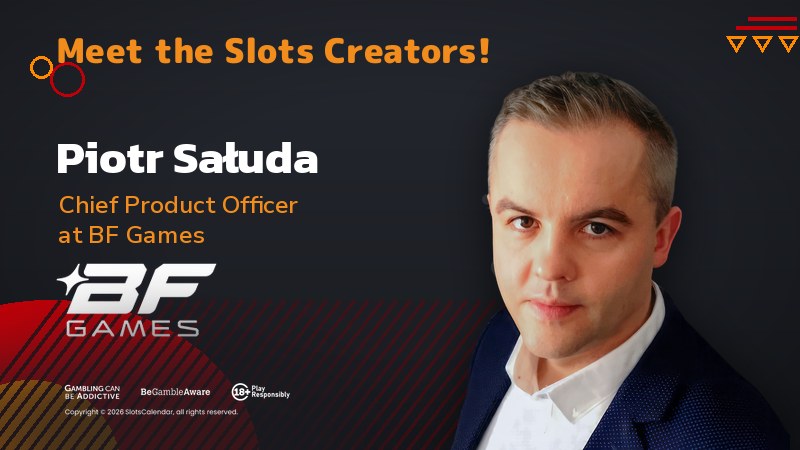
Piotr Sałuda transitioned from Product Owner to Chief Product Officer at BF Games in December 2025. In his exclusive interview with SlotsCalendar, he explains the difference between the roles and how this impacts his responsibilities.
From the finesse of creating worthwhile sequels to the projects and developments put forth by BF Games, Piotr reveals how the studio aims to retain its competitiveness while keeping a distinct identity.
You've moved from Product Owner to Chief Product Officer. What changed about your job the day the title changed?
As a Product Owner, my daily focus was tied directly to individual games—refining mechanics, solving design challenges, and ensuring each title delivered value to players. Moving into the CPO role didn't diminish that obsession with game quality, but my lens expanded instantly.
I moved from asking "Is this a great slot?" to "How does this slot strengthen our portfolio over the next three years?" The focus shifted to shaping our long-term product vision, aligning teams around a unified strategy, and building the operational discipline required to execute at scale, like maintaining our steady launch rhythm and expanding core pillars like Cash Mesh.
Ultimately, as a Product Owner you own the build; as a CPO you own the direction, the portfolio ecosystem, and the long-term growth of the business.
What does a Chief Product Officer actually decide that a player would never guess someone decides?
Most players assume a Chief Product Officer stays in high-level strategy meetings far removed from the actual games. What might surprise them is just how hands-on the role actually is at BF Games.
While players see a seamlessly finished title, almost every core element is a conscious product decision: from the math model, mechanics, and theme, to the exact spin rhythm and bonus triggers. My role starts with market analysis and player psychology to define what we build, but it doesn't stop there. I actively oversee development alongside our team leaders and personally test and sign off on every single game before launch.
Having that level of ownership is incredibly satisfying. Seeing a decision materialize on screen and resonate with players is easily the best part of the job.
How did you end up owning products rather than building them?
For years, I’ve operated at the intersection of business strategy and product development, which naturally shifted my focus from building individual components to owning the overall product vision.
Through that journey, I learned to view games relentlessly through the player’s eyes while demanding high quality. Experience also taught me the operational side of production - structured processes, risk mitigation, clear team communication, and avoiding sudden pivots. Building a great slot means never losing sight of who you are building it for.
As a passionate gamer myself, owning products allows me to bridge player empathy with strategic discipline, ensuring we build games that don't just launch smoothly, but genuinely become someone else’s favorite title to play.
What has to be true before a game earns a sequel? Burning Slots is on its fourth instalment and the Cave series ran to three.
At BF Games, sequels actually happen in two very different ways, and that’s what makes them exciting.
Sometimes, right during initial development, we can feel a theme or mechanic has explosive potential. When that happens, we proactively roadmap future releases like the Burning Slots or Cave series from day one. Other times, players completely surprise us with an overwhelmingly positive reaction to what was supposed to be a standalone title, and we gladly pivot to capitalize on that momentum.
Ultimately, whether planned from the start or born from a surprise hit, a sequel only happens when a game builds a truly loyal audience and proves there’s a genuine appetite for a fresh take on a formula players already like.
Walk me through how Cash Mesh went from an idea to a feature you now trust across different titles.
The Cash Mesh feature holds a special place in my heart, mainly because Buffalo Trail was one of the first games I managed end-to-end at BF Games. It was an ambitious risk, combining rich visuals with a novel coin-collection mechanic and progressive jackpots. When Buffalo Trail exploded across markets, we made the strategic choice to expand Cash Mesh into an ecosystem of six distinct titles and three jackpot models. This includes our "Ultra" version for more frequent drops, and "Cash Mesh LINK", which connects jackpot pools across games for faster growth and cross-game wins.
The response to LINK has been so strong that Cash Mesh transitioned from a single feature into a core long-term pillar for us. In fact, we’ve already greenlit two major additions to the Cash Mesh LINK lineup, set to launch in 2027 and 2028.
You've said BF Games pairs a strong math model with the art team's world-building. When those two pull in different directions, how does that conversation actually go?
While direct friction is surprisingly rare, every studio faces the classic clash between art and math. For us, that conversation is always driven by data, player behavior, and finding the right balance.
There are times where an incredible visual presentation sets huge expectations, but post-launch performance falls short. The culprit is usually a mismatch in the math model, so we analyze the data and apply those lessons to refine future titles.
On the flip side, when visuals feel weaker but players fall in love because the math hits the sweet spot, we don't let that model go. We take that proven mathematical backbone and pair it with an upgraded, top-tier visual presentation in our next release to hit true synergy. Ultimately, it’s a continuous learning loop where art and math push each other to make the product better.
Fruit slots keep coming back while the market chases novelty. What do classic themes do for a player that a new mechanic can't?
Classic fruit themes offer something complex mechanics often struggle to provide, immediate clarity and effortless comfort.
A large portion of players don't want to decipher complicated rules every time they spin. Fruit slots naturally pair with clean, intuitive gameplay where the rules are clear from the very first second. The familiarity of the theme removes cognitive friction, allowing players to simply relax and enjoy the rhythm of the game.
In a saturated market, nostalgia alone isn't enough. That’s why our approach is about balance. While classic themes fulfill that desire for simplicity, we constantly explore fresh themes and mechanics, ensuring that when a player discovers something bold and unique, they remember it came from BF Games.
How do you decide a new mechanic deserves its own name and a place on the front of the game? Zap!Pots debuted as a named mechanic in Megacity.
We brand and showcase a mechanic when it acts as the primary heartbeat of the gameplay and brings something distinct to our portfolio, which was exactly the case with Zap!Pots in Megacity.
In a world overflowing with similar themes, naming a dominant feature serves two strategic purposes. First, it instantly sets the title apart on the casino lobby grid, signalling to players that there's a unique experience waiting inside. Second, modern players often search for games by their core mechanics rather than their titles. With so many games sharing similar visual hooks, players form strong attachments to specific styles of play.
Giving a flagship feature a memorable name (and placing it front and center on the game tile) makes it easy for players to recognize the gameplay loop they love and associate that innovation directly with BF Games.
FK Žalgiris Legacy was built for one club's fans, in one market, with one operator. What did designing for such a specific audience teach you that a global release never would?
It taught us the unmatched power of identity and belonging. When players deeply identify with a theme (whether a football club, a sport, or local culture) emotional engagement reaches a completely different level. Games like FK Žalgiris Legacy trigger a sense of pride that a generic global release simply cannot replicate.
However, designing for a passionate fanbase demands extreme care. When emotion is high, the margin for error is razor-thin. A wrong shade of a team's colors or an inaccurate cultural reference might pass unnoticed by a casual player, but it immediately alienates die-hard fans. This project proved that niche targeting requires absolute authenticity. When you deeply respect a specific community, you build a level of trust that goes far beyond traditional game mechanics.
How do you tell whether a game underperformed because of the game or because of where it landed in the lobby?
Lobby placement dictates discovery, but game design dictates retention. With operators managing hundreds of providers and constant new releases, a game can easily get buried due to promotional pushes or simple curator preference, causing global volume to drop. To look past the lobby position, we dive into behavioral metrics that reveal true player interest like rounds per player, session length, and return rates.
If a game gets low impressions but those who find it play deeply and return day after day, we know the product itself is strong, it just has a distribution issue. On the other hand, high lobby visibility with weak retention points straight to a product flaw. We deeply value partners who look beyond initial traffic metrics to evaluate retention data, moving top-performing games into premium lobby spots where they belong.
BF Games ships roughly one slot a month. What does that pace make impossible?
We are proud to have consistently delivered at least one title a month for the last years, reaching up to 16 games a year recently. That pace requires extreme production discipline and long-term foresight - right now, we are actively developing games slated for launch late next year and even into Q1 2028.
What that rhythm makes virtually impossible is spontaneous, impulsive pivots. When your roadmap is locked, you lose the luxury of instantly greenlighting ad-hoc ideas to chase sudden trends. Even fantastic concepts matching a fresh market gap must wait their turn in the pipeline. We can afford one or maximum two games added to the previously agreed plan to not destroy the roadmap.
It demands patience, but ensures quality and structure. Fortunately, many of those exciting, long-mullered ideas are finally approaching their release dates, so keeping an eye on our portfolio will definitely be worth it.
A year from now, what would you want an operator to say about BF Games that they couldn't quite say today?
While every provider dreams of hearing "you're our absolute top-one partner," I prefer to keep our goals grounded in real, tangible impact. A year from now, I want operators to say: "BF Games keeps delivering higher-quality titles, and their promotional toolset has become an essential revenue driver for us."
In such a competitive business as iGaming is, simply standing out isn't enough. We are constantly sharpening our game development, so we want operators to recognize that step up in quality and proactively champion our latest releases. On top of that, we recently launched our new tournament and mission promotional engine. Seeing that tool become a fan-favorite among operators (actively driving higher retention, acquiring new players, and boosting their bottom line) would be the ultimate proof that we're delivering true value.
This interview was authored by Andrei Vlaicu, with special thanks to Piotr Sałuda for his invaluable contribution to the creation of this piece.