

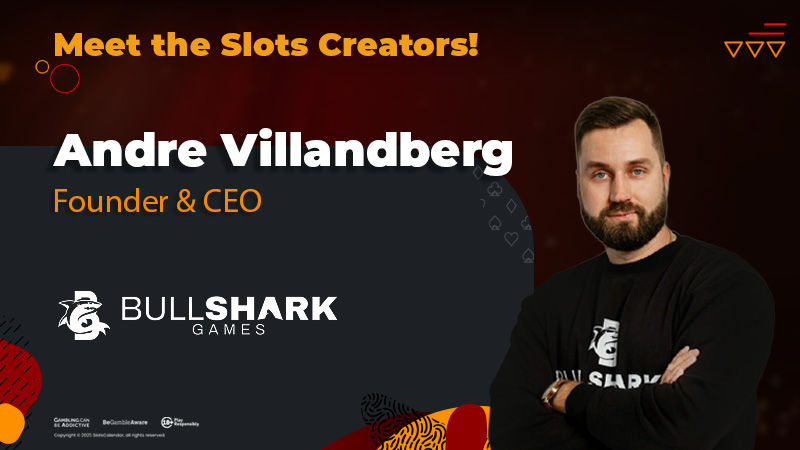
Bullshark Games, spearheaded by its founder, Andre Villandberg, provides some of the most intense games in the industry. Characterized by their signature high-volatility slots, their releases are fascinating games that are all about creating and rewarding tension.
From their sense of flow to their pay-off mechanisms that keep players engaged, Bullshark Games know that each slot release is a new opportunity to state their claim on a market spot. Read our exclusive interview to see what defines their development ideas and process!
For readers meeting Bullshark Games for the first time, how would you describe a “Bullshark game” in one sentence?
A Bullshark game is built to feel like every spin matters: volatile, high-energy, and always building toward a moment.
Since our last interview, you’ve released games like Age of Seth, Valhalla: Wild Winter, Clover Club, Paper Biker and more. What changed the most in how you think about game design over this past year?
We’ve started focusing more on flow, not just features or big wins, but how it all connects. The transitions, the pacing, the way players move through a session. That’s where the magic happens, and it’s made us much more intentional with how we design everything from the first spin to the final cascade.
You’ve said you want every spin to feel like it’s “building toward something.” When you start a new project, how do you turn that feeling into concrete decisions about reels, grid size, or features?
We start by asking: what’s the “tension engine” in this game? That could be a multiplier ladder, a collection system, or expanding reels, but there has to be something that builds, and builds, and then either breaks or rewards you. From there, we pick the format that supports that engine best.
Many studios talk about volatility; you actually lean into extreme volatility as part of your identity. How do you make those high-risk games feel exciting rather than simply punishing for everyday players?
Volatility without feedback feels punishing. But if players can see the tension build, whether it’s a growing multiplier or near-misses stacking up, then even losing spins still feel like progress. It’s about visualising risk and reward, not hiding it.
A lot of Bullshark titles use progression tools like cell multipliers, walking wilds, or growing global multipliers. How do you decide when a mechanic should slowly build tension versus when it should deliver one huge “punch” and then reset?
It depends on the story the game is telling. If the theme is about chaos or unpredictability, like in Valhalla: Wild Winter then we lean into punchier, reset-heavy mechanics. If it’s more mythic or epic, like Age of Seth, that’s where long-form progression works best. We match the mechanic to the tone.
You’ve experimented with several formats: lines, cluster pays, scatter pays, activator mechanics, multiple bonus buys. From a player’s point of view, what experience do you want them to have that feels consistent across all these different math models?
No matter the format, we want players to feel like the game has gears, that it can shift up into something bigger, more intense. That sensation of escalation is what ties everything together across formats.
You often say you spin your own games tens of thousands of times before release. Can you walk us through a concrete moment when those “real” test sessions made you change or even scrap a feature?
In Paper Biker, we had a version where helmet symbol upgrades happened less often but paid more. On paper it worked fine, but in real sessions, it just felt dry, too much waiting, not enough payoff. We adjusted it so players see more upgrades throughout, even if they’re smaller, and the game immediately felt more alive.
Younger audiences grew up on multiplayer and skill-feeling games, not just solo spinning. How do you see Bullshark games speaking to that Gen Z crowd without losing the simplicity slot fans still enjoy?
We don’t try to turn slots into video games. But what we do try to do is give players the sense that they’re affecting the outcome. Whether it’s collecting something, unlocking levels, or making progression visible, those design choices add that feeling of agency Gen Z players grew up expecting.
Imagine a player lands on a Bullshark slot through a casino bonus or a welcome offer. What do you want that first session to teach them about your games, beyond “this can pay big”?
That the game has layers. That what looks like a simple cluster or multiplier game is actually building something deeper and if they stick with it, they’ll find those moments where everything suddenly clicks.
From where you sit, what are casinos and affiliates still getting wrong when they talk about high-volatility games and bonuses? If you could give them one sentence to use next to a Bullshark promo, what would it be?
“Big risk, big reward, and a ride worth taking.”
Too often, volatility is treated like a warning. But players don’t mind risk, they mind boredom. And that’s what we want to avoid.
Independent studios like yours are often described as the “experimental lab” of the industry. Day to day, what freedom do you actually feel compared to big legacy providers, and where do you still hit walls?
We have the freedom to try weird things. But we also have to be smart about what actually works. We can’t afford vanity projects, every game has to earn its place. So we get to experiment, but there’s no safety net, and that’s what keeps us sharp.
Looking ahead 2–3 years, which direction excites you more for Bullshark: pushing volatility and surprise even further, or exploring things like multiplayer, tournaments, or more “social” slot experiences?
Honestly, both. We’ll keep dialing up volatility in clever ways, but we’re also looking at how to make slots feel more reactive, more alive. Whether that’s shared progress, community goals, or something we haven’t named yet, the social layer is definitely calling.
Finally, can you tease one upcoming Bullshark release that, in your opinion, has “potential Game of the Year” written on it – and tell us in one or two details what makes it different from anything you’ve shipped so far?
We’ve got a game coming where the base play doesn’t just lead to the bonus, it previews it. You get constant glimpses of how Free Spins will work, so when you finally trigger them, there’s already a sense of familiarity and anticipation. Once inside, the bonus fully opens up with levels, progression, and real momentum. It’s a format that bridges base and bonus in a more connected way than anything we’ve done before.
This interview was authored by Andrei Vlaicu, with special thanks to Andre Villandberg for his invaluable contribution to the creation of this piece.